
UK buyers usually assess foam glass by thermal conductivity, declared thermal resistance, moisture behaviour, load, and the form required for the project.
Foam glass insulation, also called cellular glass, is a rigid inorganic insulation made by foaming glass into sealed cells. Its R-value depends on the selected grade and thickness; boards, pipes, fittings, and gravel serve different UK applications.
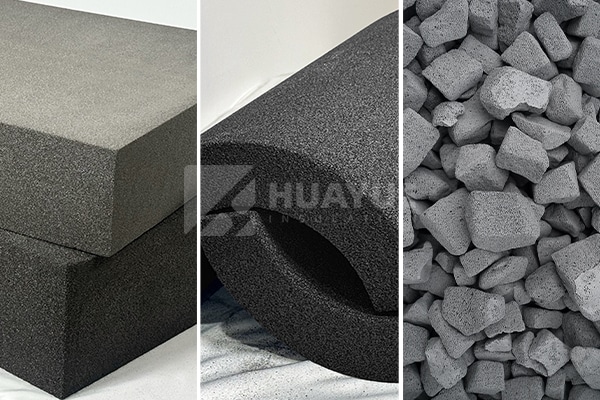
This guide answers what glass foam insulation is, where it is used, how to interpret its R-value in UK specifications, and what happens when the material is exposed to water.
What Is Glass Foam Insulation?
The name can sound similar to glass wool or plastic foam, but the material structure and buying criteria are different.
Glass foam insulation is a rigid cellular-glass product made by heating glass and a foaming agent until a closed-cell structure forms. It is supplied as boards, pipe sections, fittings, blocks, or aggregate rather than as a flexible fibre blanket.
Foam glass, foamed glass, and cellular glass are commonly used as category terms for this type of insulation. They should not be confused with glass wool, which is a fibrous product, or with plastic foams such as PIR, PUR, or XPS. FOAMGLAS® is also a registered product brand; it is not a generic name for every cellular-glass product.
The manufacturing route normally starts with processed glass, often including recycled glass, which is ground, mixed with a foaming agent, heated, and cooled under controlled conditions. The result is a lightweight rigid material containing many sealed glass cells. The cell structure is what gives cellular glass its combination of thermal resistance, vapour resistance, dimensional stability, and compressive performance. The exact result still depends on the named product, density, formulation, and test method.
For a UK project, the useful distinction is not only “foam glass or not”. It is also the physical form and the duty:
- Board or slab: used for floors, roofs, walls, foundations, below-ground and perimeter insulation, and other building-envelope positions.
- Pipe, block, or fitting: used to insulate straight pipework, elbows, flanges, tanks, vessels, and equipment where preformed geometry reduces site cutting.
- Gravel or aggregate: used as lightweight insulating fill, under-slab material, backfill, or in civil and landscape applications. Aggregate grades may have different cell structures, so their data must not be copied from board products.
The HUAYUE foam cellular glass insulation range shows these forms and separates product families by density, thermal conductivity, compressive strength, water absorption, and application. That is the level of detail a quotation should retain.
What Is Foam Glass Insulation Used For?
Foam glass is selected when thermal insulation must work alongside moisture control, fire performance, mechanical strength, or long-term dimensional stability.
Foam glass insulation is used in building envelopes, below-ground structures, floors, flat and green roofs, process pipework, tanks, vessels, cryogenic systems, and lightweight insulating fill. The correct form depends on the load, temperature, geometry, and exposure.
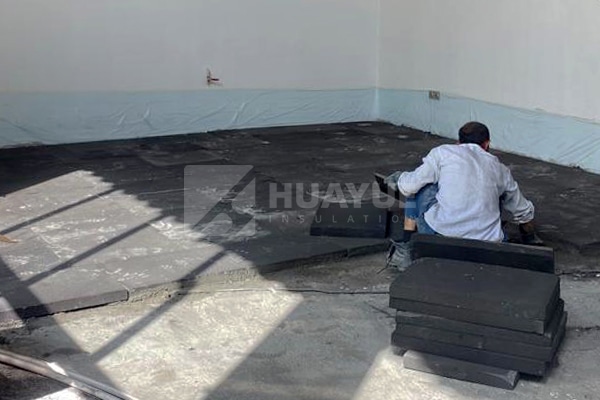
In UK building work, board or slab products may be considered for:
- below-ground floors, foundation slabs, basements, and perimeter insulation;
- flat roofs, heavy-duty roof areas, green roofs, and roof systems under a compatible membrane;
- internal or external walls, floors, and other areas where a rigid vapour-resistant insulation layer is required; and
- thermal breaks or load-bearing insulation positions where the design permits the selected compressive grade.
In industrial work, preformed pipe and fitting products are used on hot, chilled, low-temperature, and cryogenic pipework, as well as tanks, vessels, equipment, and tank bases. The reason for specifying cellular glass in these environments is usually a combination of conditions rather than one headline benefit: the engineer may need low heat transfer, resistance to moisture ingress, non-combustibility, resistance to compression, or compatibility with a detailed insulation and weatherproofing system.
Foam glass gravel serves a different purpose. It can provide lightweight, insulating fill below slabs, in backfill, or in civil and landscaping work. It is not a substitute for a board or pipe product simply because both are made from glass. Particle size, open-cell or closed-cell structure, bulk density, compaction, drainage, and compressive behaviour must be checked against the ground or fill design.
The product page should therefore be treated as a starting route, not as a universal specification. For a UK enquiry, ask for the named form, thickness or particle size, density or grade, thermal conductivity, compressive data, water absorption, fire classification where needed, facing or coating, and the documents required by the project team. For work in England, also keep the building element’s target U-value and condensation assessment separate from the insulation material’s own thermal value; Approved Document L addresses energy performance at building-element level.
What Is the R-Value of Foam Glass Insulation?
“R-value” is not one fixed property of all foam glass; UK buyers usually need the declared lambda value or thermal resistance for a named product and thickness.
The current HUAYUE board table lists average thermal conductivity values of 0.040–0.056 W/(m·K) at 10°C, depending on model. That is approximately RSI 0.45–0.63 m²K/W per 25 mm, or about US R-2.6–R-3.6 per inch by simple conversion.
The calculation is straightforward for a uniform insulation layer:
RSI = thickness in metres ÷ thermal conductivity in W/(m·K)
Using the published 0.040–0.056 W/(m·K) range as a planning example gives the following approximate material-layer values:
| Layer thickness | Approx. RSI, m²K/W | Approx. US R-value |
|---|---|---|
| 25 mm | 0.45–0.63 | R-2.6–R-3.6 |
| 50 mm | 0.89–1.25 | R-5.1–R-7.1 |
| 100 mm | 1.79–2.50 | R-10.2–R-14.2 |
These figures are derived from the stated lambda range, not a replacement for a product datasheet or a whole-assembly calculation. The selected grade, density, temperature range, test basis, thickness tolerance, joints, facings, membranes, fixings, and workmanship can all affect the result. A pipe section also has curved geometry and operating-temperature conditions, so its performance should not be inferred from a flat-board calculation.
This is why UK technical submittals often lead with λ in W/(m·K), R or R_D in m²K/W, and the element U-value in W/(m²·K). A higher material resistance generally reduces heat flow through that layer, but it does not by itself prove that a wall, roof, tank, or pipe system meets its design target. Thermal bridges, joints, supports, moisture control, and surface resistances remain part of the design.
When reviewing a foam glass quotation, confirm these four points:
- The named product and physical form, not only the phrase “foam glass”.
- The declared lambda or thermal resistance, test temperature, and thickness.
- The required compressive strength and geometry for the real load or pipe diameter.
- Whether the project needs a material value, an assembly U-value, or both.
Can Foam Glass Get Wet?
Water exposure is one of the reasons engineers consider cellular glass, but the answer depends on the product form and the complete installed system.
Foam glass boards and pipe products have sealed glass cells and are designed to resist water absorption. They can be exposed to surface moisture without behaving like a wicking fibre, but joints, coatings, membranes, supports, and foam-glass gravel still require product-specific review.
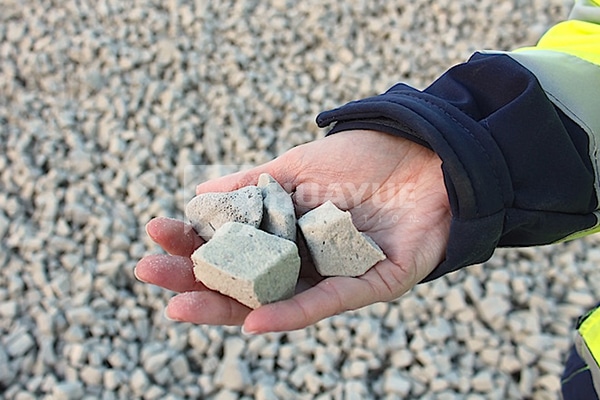
The current HUAYUE board table lists water absorption at no more than 0.50 volume percent and water-vapour permeability at no more than 0.007 ng/(Pa·s·m), with the scope and test method tied to the published product table. These values support a moisture-resistant material choice, but they do not mean that every installation is automatically watertight. Water can still enter through damaged weatherproofing, open joints, poorly sealed penetrations, cracked coatings, or interfaces between different materials.
There is also an important difference between the insulation core and the surrounding structure. Cellular glass may limit water uptake, while the steel, concrete, adhesive, membrane, cladding, or pipe support around it still needs drainage and corrosion control. In an industrial system, moisture protection should be reviewed together with the vapour retarder, jacketing, joint treatment, supports, and inspection plan. In a roof or below-ground build-up, the membrane and drainage design remain responsible for managing bulk water.
Do not transfer board or pipe claims to gravel. HUAYUE lists both open-cell and closed-cell foam-glass gravel products, and an aggregate’s particle size, voids, grading, compaction, drainage, and ground contact affect its behaviour. If the gravel is intended below a slab or in a backfill zone, confirm the exact grade and design assumptions rather than using a board’s water-absorption or thermal-resistance value.
For UK procurement, the practical question is therefore not simply “Can it get wet?” It is “What water exposure is expected, and which named product, jointing method, membrane, drainage layer, and test data address it?” Include the application, operating or ground condition, and target thermal value in the first enquiry. Huayue can then discuss suitable board, pipe, fitting, or gravel forms, along with dimensions, density, packaging, and project-document requirements.
Conclusion
Choose foam glass by form, thermal value, load, and moisture exposure—not by the generic name alone. Share the UK application and target λ, RSI, or U-value for review.