

Cellular glass block is a high-performance insulation material valued for its durability, fire resistance, and moisture impermeability in demanding industrial and commercial environments.
Cellular glass block is a rigid insulation made from crushed glass and foaming agents, offering excellent thermal insulation, non-combustibility, and resistance to moisture and chemicals, making it ideal for industrial, commercial, and specialized construction applications.
What is cellular glass insulation used for?
Cellular glass block insulation is widely used in industrial, commercial, and specialized construction projects where moisture resistance, fire safety, and long-term durability are critical. Typical applications include insulating process piping, storage tanks, cryogenic systems, flat roofs, and building envelopes. Its closed-cell structure prevents water and vapor ingress, making it suitable for below-grade and underground installations.
In chemical plants and refineries, cellular glass block protects against corrosion under insulation (CUI), as it does not absorb liquids or support microbial growth. It is also favored in cold storage facilities, LNG terminals, and data centers, where stable thermal performance and non-combustibility are essential for safety and operational reliability.
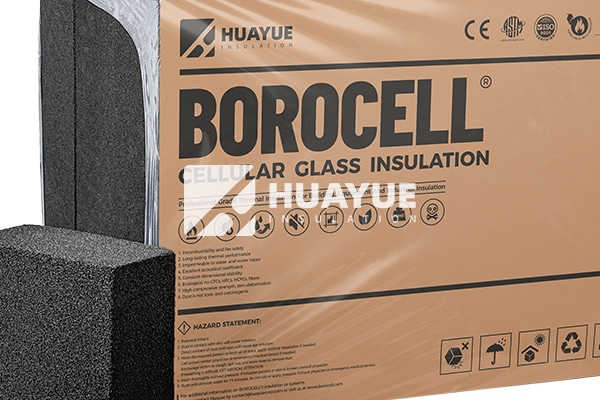
Is foam glass the same as cellular glass?
Yes, foam glass is another term for cellular glass. Both refer to the same type of insulation material produced by heating crushed glass with a foaming agent, resulting in a rigid, closed-cell structure. The terms "foam glass" and "cellular glass block" are used interchangeably in the insulation industry.
However, "cellular glass block" specifically refers to the material supplied in block form, which is then cut or shaped for various applications. Foam glass may also be available as boards, pipes, or gravel, depending on the manufacturing process and intended use. Regardless of terminology, both offer the same key properties: non-combustibility, moisture resistance, chemical durability, and high compressive strength.

What is the R-value of cellular glass insulation?
The R-value of cellular glass block insulation typically ranges from R-3.1 to R-3.4 per inch (RSI 0.54 to 0.60 per 25 mm), depending on density and manufacturing process. This means it provides reliable thermal resistance for a variety of temperature control and energy conservation applications.
While its R-value is comparable to other rigid insulation materials, cellular glass block stands out for its consistent performance over time. Unlike some organic foams, it does not degrade, absorb water, or lose insulating ability when exposed to harsh environments. This makes it a preferred choice for applications requiring stable, long-term thermal insulation.
Does foam glass block insulate well?
Foam glass block insulates well, especially in environments where moisture, fire, or chemical exposure are concerns. Its closed-cell structure ensures that thermal conductivity remains low and stable, even under mechanical load or exposure to harsh conditions.
Compared to other rigid insulation types like PIR/PUR foam or mineral wool, foam glass block offers unique advantages:
| Property | Cellular Glass Block | PIR/PUR Foam | Mineral Wool |
|---|---|---|---|
| Water Absorption | 0% (impermeable) | Can absorb | Can absorb |
| Fire Resistance | Non-combustible | Limited | Non-combustible |
| Compressive Strength | High | Moderate | Moderate |
| Chemical Resistance | Excellent | Poor-Fair | Good |
| R-value (per inch) | 3.1–3.4 | 6–7 | 3.7–4.2 |
While its R-value is lower than some organic foams, the total lifecycle performance and safety profile make foam glass block an excellent choice for critical industrial and commercial insulation.
What should B2B buyers know about cellular glass block #5?
When considering cellular glass block for industrial or commercial projects, B2B buyers should evaluate several factors beyond technical performance:
- Specifications: Cellular glass block is available in various densities, sizes, and compressive strengths. Confirm compliance with project requirements and relevant standards.
- Quality Consistency: Reliable suppliers provide consistent block quality, with uniform cell structure and dimensional accuracy. Request sample blocks or third-party test reports if possible.
- Packaging and Shipment: The material is typically packed on pallets and may require protection from breakage during transit. Confirm packaging details and shipment insurance.
- Lead Time and Supply: Cellular glass block production can have longer lead times than common insulation materials. Plan procurement schedules accordingly, especially for large or custom orders.
- Customization: Some manufacturers offer pre-cut or shaped blocks to fit pipes, tanks, or unique geometries, reducing on-site labor.
- Lifecycle Cost: Although initial material costs are higher than some alternatives, cellular glass block offers long-term savings through durability, zero maintenance, and stable thermal performance.
- Certifications: Ensure the product meets relevant fire safety, environmental, and industrial standards for your region or sector.

FAQ
Q1: Can cellular glass block be used below grade or underground?
A1: Yes, cellular glass block is ideal for below-grade and underground insulation due to its impermeability to water and resistance to soil chemicals.
Q2: Is cellular glass block affected by rodents or insects?
A2: No, cellular glass block is inorganic and does not provide a food source for pests, making it immune to rodent and insect damage.
Q3: How is cellular glass block installed?
A3: It is typically installed using compatible adhesives or mortars and may be mechanically anchored for large-scale or vertical applications.
Q4: Does cellular glass block release toxic gases in a fire?
A4: No, cellular glass block is non-combustible and does not emit toxic fumes when exposed to fire.
Q5: What is the typical service temperature range for cellular glass block?
A5: Cellular glass block generally performs in temperatures from -260°C to +430°C, suitable for both cryogenic and high-temperature applications.
Conclusion
Cellular glass block delivers durable, fire-safe, and moisture-resistant insulation for demanding B2B projects, offering long-term performance and reliability where conventional materials may not suffice.